
Luton Town Power Court Stadium: Plans, History and Construction Updates
Power Court is the future home of Luton Town Football Club and one of the most significant regeneration projects in the history of Luton.
The new 25,000-seat stadium is being built on a former industrial site beside Luton town centre, close to Luton railway station, the University of Bedfordshire and St Mary’s Church.
It will eventually replace Kenilworth Road, Luton Town’s home since 1905, providing more than double the capacity of the club’s historic ground and considerably improved facilities for supporters, players, media and commercial operations.
Construction of the main stadium began after years of land preparation, planning and major underground infrastructure work. The club is targeting the start of the 2028/29 football season for the first competitive match at Power Court.
Power Court Stadium at a glance
- Current Power Court construction status – August 2026
- Power Court construction during 2026
- What is Power Court?
- When will Power Court Stadium open?
- Power Court Stadium design
- What else is being built at Power Court?
- The River Lea at Power Court
- Power Court public square
- History of Power Court
- History of Kenilworth Road
- Luton Town’s plans to leave Kenilworth Road
- Power Court construction during 2025
- How will supporters travel to Power Court?
- Power Court construction timeline
- Latest Power Court construction videos
- Frequently asked questions
Current Power Court construction status – August 2026
Construction of Luton Town’s new stadium is now clearly rising above ground.
The West Stand is the most advanced part of the stadium, with substantial sections of its concrete structure reaching an intermediate level. Concrete columns are also rising around the South Stand, while foundations and piling define the footprint of the East Stand.
The tower cranes above Power Court now dominate this part of the Luton skyline and mark the transition from underground preparation to construction of the visible stadium structure.
Power Court construction during 2026
Construction of Luton Town’s new stadium accelerated significantly during 2026. Piling began across the stadium footprint, tower cranes appeared above central Luton and the concrete structure of the West and South stands began to rise.
West Stand
The West Stand is currently the most advanced part of Power Court. It will contain many of the stadium’s principal facilities, including hospitality areas, media accommodation, executive spaces and operational rooms.
The plans also include a television gantry, hospitality lounges, executive boxes, conference facilities and a tunnel club.
South Stand
Construction of the South Stand accelerated during summer 2026, with concrete columns and structural sections beginning to rise above the foundations.
As these elements are joined together, the southern edge of the stadium bowl is becoming increasingly visible from St Mary’s Road and the surrounding town centre.
East Stand
The East Stand remains at an earlier construction stage than the West Stand, but foundations and piling now identify the eastern edge of the future stadium bowl.
North Stand
The North Stand is positioned closest to the railway side of Power Court.
Stadium infrastructure and back-of-house accommodation will be concentrated towards the northern side of the development, including an integrated energy centre.
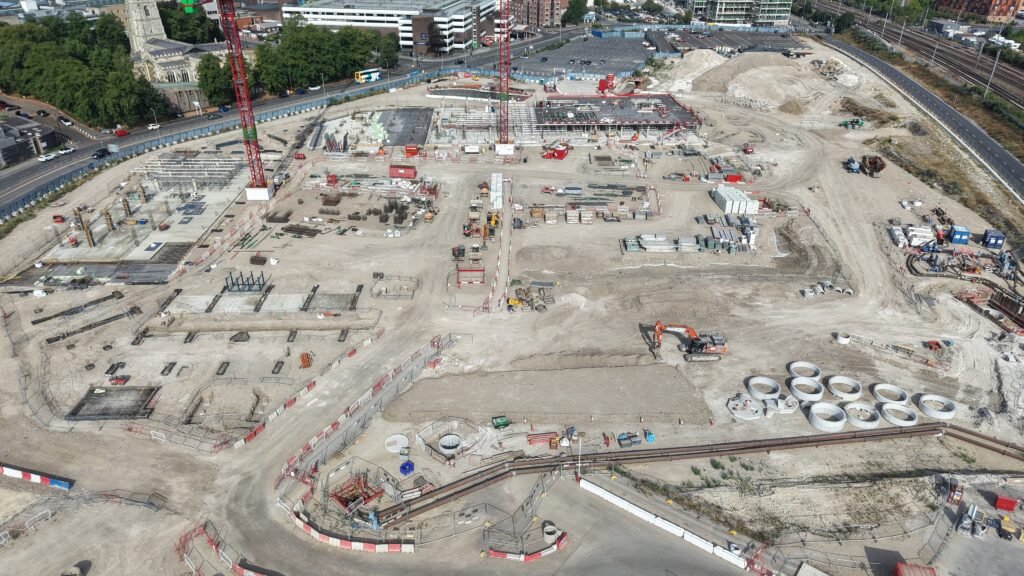
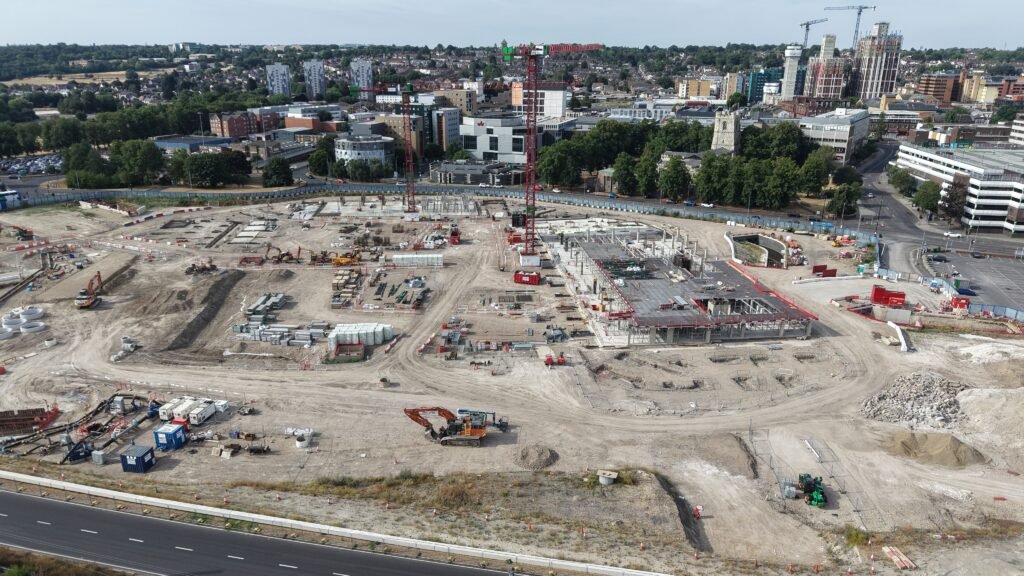
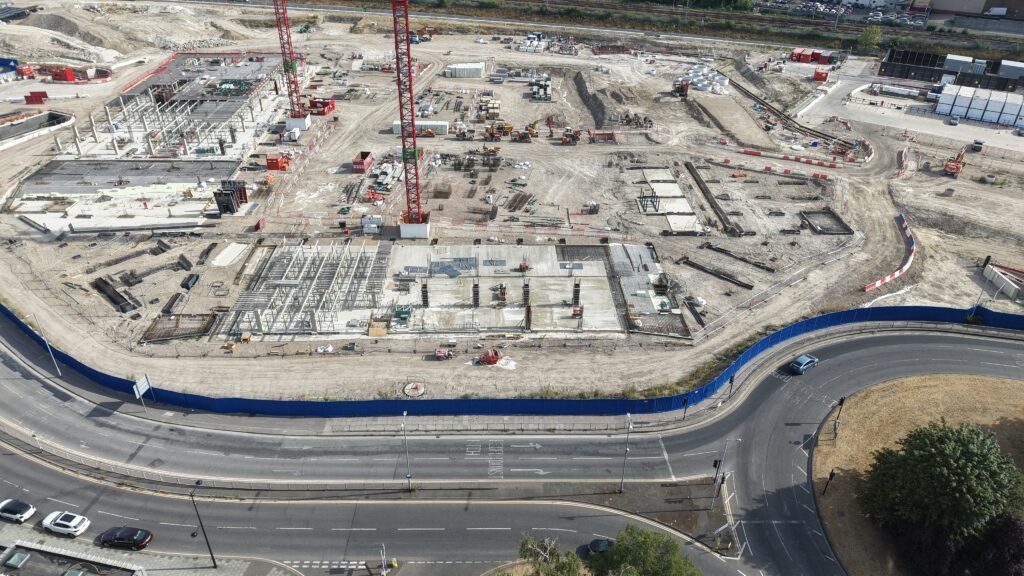
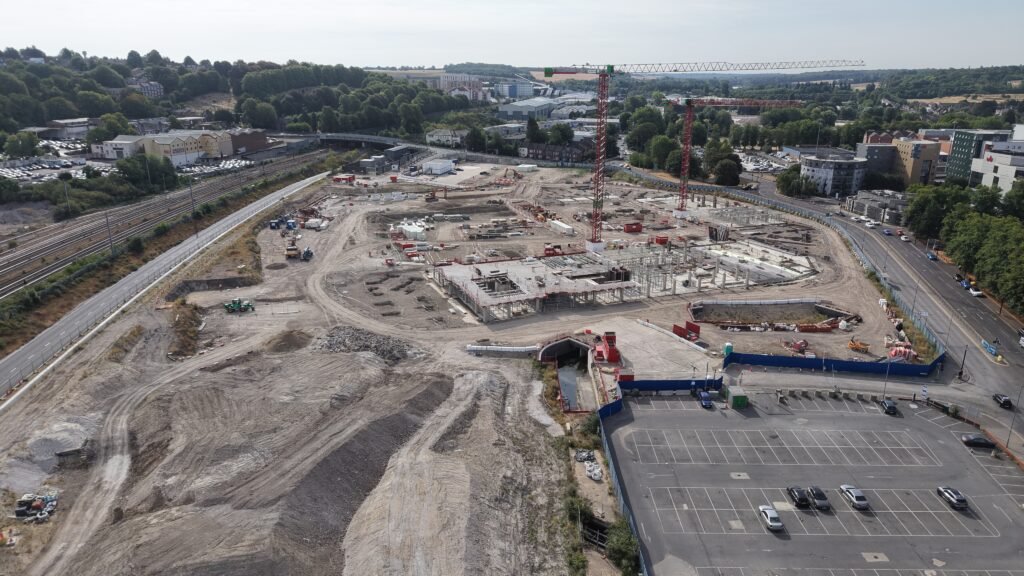
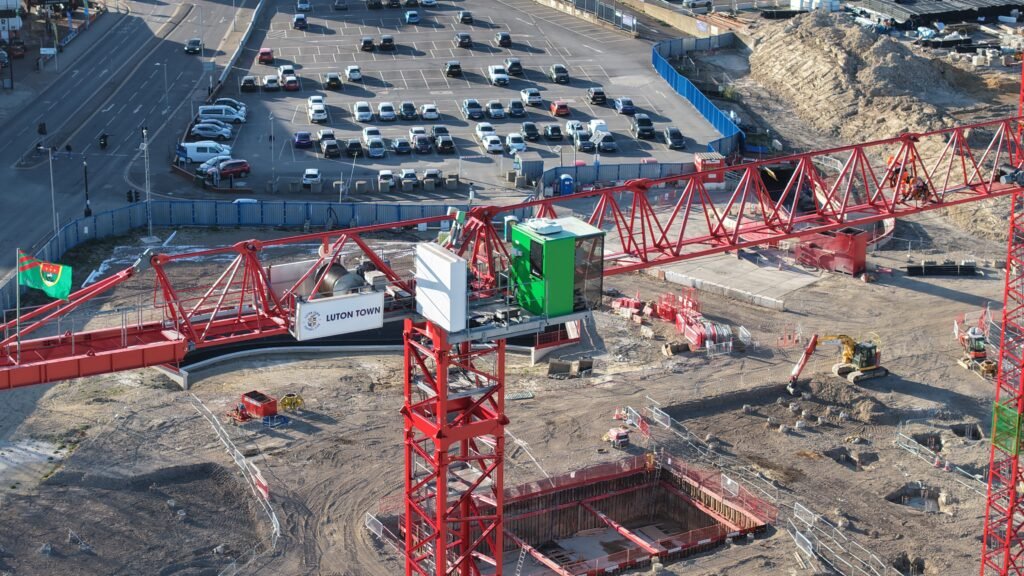
Power Court tower cranes
Tower cranes began appearing at Power Court during spring 2026.
They are being used to lift reinforcement, formwork, concrete components and other heavy structural materials around the stadium footprint. Their arrival marked the transition from piling and underground preparation to construction of the visible stadium superstructure.
What is Power Court?
Power Court is a major brownfield site on the eastern side of Luton town centre.
The site is bounded by Church Street, St Mary’s Road, Crawley Green Road and the railway and Luton–Dunstable Busway corridor. It lies only a short distance from Luton railway station and immediately beside the Grade I-listed St Mary’s Church.
At the centre of the development will be Luton Town’s new 25,000-capacity football stadium. The wider regeneration plans also include new homes, a hotel, food and drink venues, commercial space, improved public areas and a music and entertainment venue.
The stadium will include:
- approximately 25,000 seats;
- modern hospitality and executive areas;
- improved facilities for disabled supporters;
- media and broadcasting accommodation;
- conference and event spaces;
- food and beverage outlets;
- club offices and operational areas; and
- new pedestrian connections with the town centre.
The development is intended to provide Luton Town with a stadium capable of supporting the club at the highest levels of English football while also helping regenerate a large part of central Luton.
Power Court in central Luton, the site of Luton Town Football Club’s new stadium.
When will Power Court Stadium open?
Luton Town is targeting the start of the 2028/29 football season for its first full season at Power Court.
The main stages of construction include:
- Ground remediation and site preparation
- Deep foundations and piling
- Construction of the concrete stadium structure
- Structural steelwork and roof installation
- Cladding and external finishes
- Mechanical, electrical and internal fit-out
- Pitch installation, testing and commissioning
The opening date remains a target and could change if the project encounters unexpected ground conditions, utility complications or construction delays.
Power Court Stadium design
Power Court has been designed as a football-first stadium, with its stands positioned close to the pitch to help create the enclosed atmosphere associated with Kenilworth Road.
The stadium plans include:
- four covered stands;
- approximately 25,000 seats;
- around 2,750 safe-standing spaces;
- hospitality lounges and executive boxes;
- a tunnel club;
- conference and event facilities;
- television and media accommodation;
- food and drink concessions;
- community spaces; and
- facilities for concerts and other events.
The stadium will primarily host Luton Town matches, although the planning permission also allows a limited number of concerts each year.

Safe standing at Power Court
The approved design includes approximately 2,750 safe-standing spaces. Rail seating will allow these areas to operate as seated accommodation when necessary while enabling supporters to stand safely where regulations permit.
What else is being built at Power Court?
Power Court is intended to become a new town-centre neighbourhood rather than functioning only as a football stadium.
The wider plans include:
- around 1,200 homes;
- a hotel of approximately 150 rooms;
- an approximately 1,800-capacity music venue;
- a health centre;
- shops and commercial units;
- restaurants, cafés and bars;
- landscaped public areas;
- new pedestrian and cycling routes; and
- improvements to the River Lea.
The stadium will act as the anchor for an area designed to remain active throughout the week, not only on matchdays.
The River Lea at Power Court
The River Lea historically crossed much of Power Court through underground culverts.
During 2025, a new section of the river was constructed around the stadium development. Water began flowing through the diverted channel in September 2025, releasing land within the centre of Power Court for the stadium.
The river will eventually form part of the landscaping and public realm surrounding the stadium, creating new green space and improving connections between Power Court and Luton town centre.
The club confirmed that water would begin flowing through the rerouted river during September 2025.
Power Court public square
A large public square is planned outside the stadium.
The space is intended to provide a gathering point for supporters before matches while also being available for markets, festivals, community activities and other events on non-matchdays.
The planned square is similar in scale to Luton’s St George’s Square and will be surrounded by a mixture of commercial, leisure and residential buildings.
History of Power Court
Power Court’s industrial past
Long before plans for a football stadium emerged, Power Court was an important industrial area.
The land was intensively developed from the end of the nineteenth century, encouraged by its position beside the railway. Historic uses included a power station, electricity generating works, the River Lea Boiler Works, engineering workshops, coal depots and a fire station.
The former power station was one of the most prominent uses of the site. It provided electricity for the growing town and helped attract other industrial businesses to the surrounding area.
Power Court was redeveloped during the 1960s and 1970s for light manufacturing and general industrial use. As part of this development, much of the River Lea was enclosed within an underground concrete culvert running across the site.
Industrial activity gradually declined, buildings were demolished and much of Power Court became vacant or was used for temporary surface parking.
By the early twenty-first century, it was recognised as one of the largest regeneration opportunities in Luton town centre.
Earlier redevelopment proposals
Several proposals were put forward for Power Court before Luton Town became involved.
A 1999 scheme known as the Gateway Project included changes to the railway and bus stations and proposed a food store on part of Power Court. The scheme did not proceed after its associated legal agreement was not completed.
A further application submitted in 2005 proposed a retail-led development with housing, leisure and community uses, but this application was never determined. British Land also explored redevelopment possibilities between 2010 and 2013 without bringing forward a final scheme.
Power Court therefore remained largely undeveloped until Luton Town Football Club identified it as the preferred location for a new stadium.
Luton Town chooses Power Court
Luton Town revealed Power Court as its preferred new stadium location during the middle of the 2010s.
Unlike several previous out-of-town proposals, Power Court offered the opportunity to keep the club within Luton and place the stadium within walking distance of the town centre and railway station.
The club submitted plans for a new stadium and wider mixed-use development in 2016. Luton Borough Council resolved to approve the outline proposals in January 2019, with formal planning permission issued in September 2019.
The proposals evolved during the following years as construction costs, the club’s ambitions and the wider economic environment changed.
Revised detailed plans for a single-phase, 25,000-capacity stadium were approved by Luton Borough Council in December 2024. The new design allowed the club to proceed directly to the stadium’s full planned capacity rather than constructing it through several expansion phases.

History of Kenilworth Road
Kenilworth Road has been the home of Luton Town Football Club for more than 120 years.
The club moved there from its former Dunstable Road ground in 1905. The first competitive match at the new stadium was played against Plymouth Argyle on 4 September 1905, ending in a goalless draw in front of approximately 5,000 spectators.
Over the following decades, Kenilworth Road was expanded and altered as Luton Town progressed through the football pyramid.
Its location between terraced housing, roads and neighbouring properties created the unusual and intimate ground familiar to supporters today. Entrances to the Oak Road Stand pass between and beneath residential properties, while spectators are positioned extremely close to the pitch.
The Main Stand
The original wooden Main Stand had been moved from the club’s former Dunstable Road ground.
It was destroyed by fire in March 1922, together with the club’s offices, dressing rooms and equipment. A replacement stand was constructed during the summer and opened for the beginning of the 1922/23 season.
More than a century later, much of that structure remains part of Kenilworth Road’s Main Stand.
Kenilworth Road through the years
Kenilworth Road has witnessed every major chapter in Luton Town’s football history.
The ground was substantially expanded as attendances increased, at one point having a reported capacity of around 34,000. It hosted the club’s first period in the top division during the 1950s and later became famous for its artificial playing surface during the 1980s.
Supporters have watched the Hatters at Kenilworth Road in every division from the Premier League to the National League.
The stadium was extensively upgraded following promotion to the Premier League in 2023. New broadcasting, media and hospitality facilities were constructed in a remarkably short period so the ground could meet Premier League requirements.
Despite these improvements, the site remains physically constrained and offers limited scope for meaningful expansion.

Kenilworth Road has been Luton Town’s home since September 1905.
Luton Town’s plans to leave Kenilworth Road
Luton Town’s search for a larger stadium stretches back many decades.
Kenilworth Road’s location among tightly packed residential streets makes substantial redevelopment extremely difficult. The current capacity of around 12,000 also limits ticket availability and the commercial income the club can generate.
The club has previously stated that these constraints make it difficult to grow, compete sustainably in the higher divisions and provide modern facilities for supporters.
Earlier stadium proposals
Several possible moves were considered before Power Court.
During the 1980s, proposals were discussed that could have taken the club towards Milton Keynes. These plans never progressed.
In the 1990s, chairman David Kohler promoted an ambitious indoor stadium commonly known as the Kohlerdome. The proposed 20,000-seat arena included a retractable roof and movable pitch, but the scheme was ultimately rejected following concerns surrounding highways and access.
Further proposals followed, including land near the M1 and a controversial 2007 plan for a stadium close to Junction 12 near Harlington and Toddington. That application was withdrawn after the Luton Town Football Club 2020 consortium took control of the club in 2008.
The new owners reassessed the club’s requirements and focused on finding a location that would keep Luton Town within the town itself.
Why Power Court was different
Power Court offered several important advantages over earlier proposals:
- it kept Luton Town in central Luton;
- it was within walking distance of the railway and bus stations;
- it provided a significantly larger development site;
- it allowed the stadium to form part of wider town-centre regeneration;
- it offered space for modern supporter and commercial facilities; and
- it could accommodate a stadium of approximately twice Kenilworth Road’s capacity.
The club purchased the site and progressed the project through several rounds of planning, design and enabling work.
Approval of the revised 25,000-seat stadium in December 2024 finally established a deliverable route away from Kenilworth Road after decades of unsuccessful proposals.
Power Court construction during 2025
The year 2025 marked the transition from planning and enabling works towards the visible construction of Luton Town’s new stadium.
Much of the work during the year took place underground or around the edges of the site. Although it was less visually dramatic than the concrete stadium structure that followed, it was essential preparation for piling and the main build.
Limak joins the Power Court project
On 30 April 2025, Luton Town announced that it had entered a pre-construction services agreement with Limak International.
Limak brought major international construction experience to the project, including involvement in the redevelopment of FC Barcelona’s Spotify Camp Nou.
The club said the agreement represented a major milestone and confirmed that construction activity would increase during the summer of 2025.
Site preparation and infrastructure works
Work during the first part of 2025 concentrated on preparing the former industrial land for the main stadium.
This included:
- clearing and preparing construction areas;
- dealing with contaminated and previously developed ground;
- relocating and protecting underground utilities;
- drainage and sewer works;
- preparing access and working areas;
- continuing work around the River Lea; and
- establishing areas required for the main construction compound.
Power Court’s former industrial use and the number of major services crossing the land made the enabling phase particularly complicated.
One of the largest challenges was the presence of a major sewer serving thousands of properties, which had to be moved before stadium foundations could progress.
River Lea diversion completed
A major milestone was reached in September 2025 when water began flowing through the newly diverted section of the River Lea.
The river had previously crossed Power Court largely through an underground culvert. Its new route took it around the edge of the development, releasing space within the centre of the site for the stadium.
The diversion also formed part of wider environmental and landscaping proposals for Power Court.
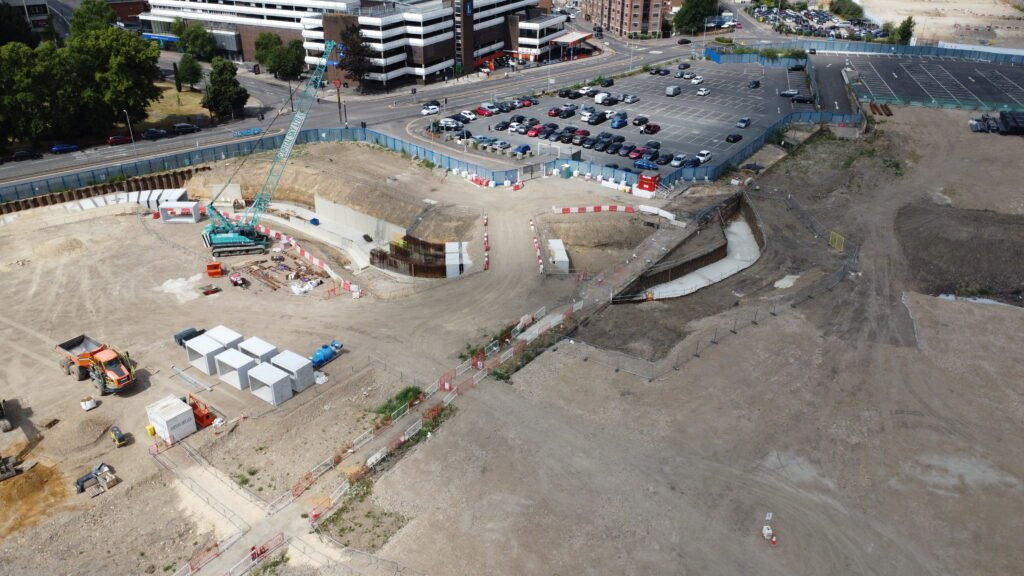
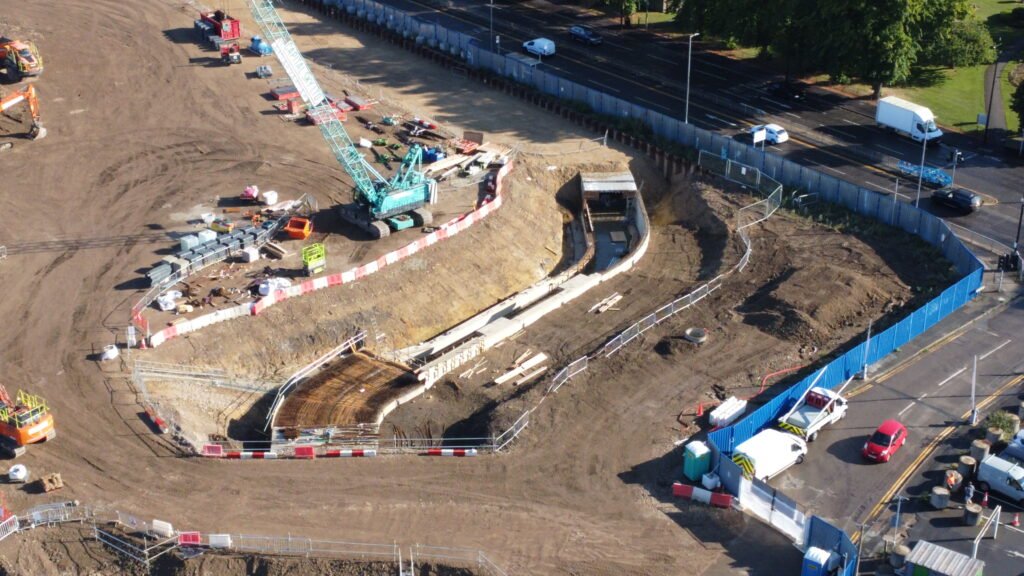
The newly diverted River Lea running around the Power Court development.
Relocation of the Power Court electricity substation
Another major obstacle to constructing the stadium was the existing electricity substation located near the centre of Power Court.
The substation formed part of Luton’s electricity distribution network and could not simply be disconnected or demolished. It first had to be replaced with a new primary substation away from the main stadium footprint.
Planning permission for the replacement facility, on land east of Pondwicks Road, was approved in November 2023. The relocation was required to release the central part of Power Court for redevelopment and allow the stadium foundations to proceed.
During 2025, the new substation was constructed, connected and commissioned. For a period, the new and old substations operated alongside each other while testing took place, ensuring that the electricity supply to the wider town could be maintained throughout the changeover.
By September 2025, the replacement substation was supplying electricity and the old facility was ready to be removed. The original substation was demolished shortly afterwards, clearing another substantial area within the future stadium site.
The demolition was an important milestone because, together with the River Lea diversion, it effectively completed the first major phase of site preparation. Attention could then move towards the sewer works, retaining structures, piling and construction of the stadium itself.
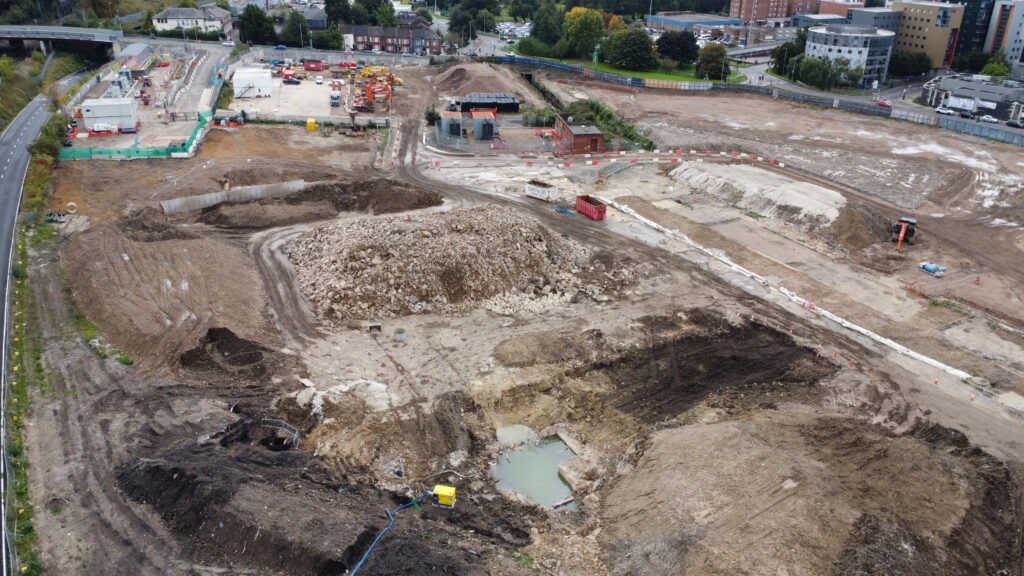
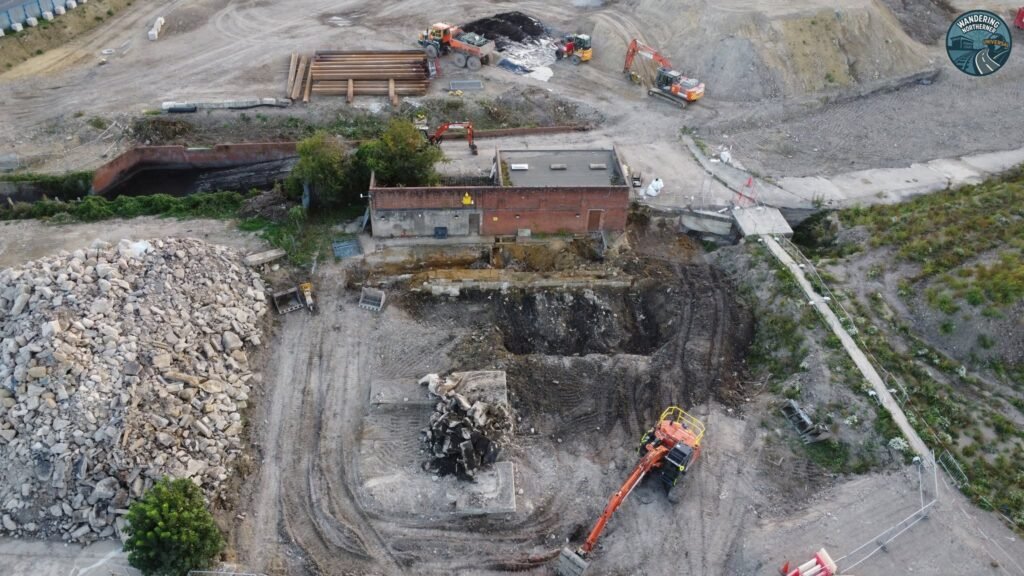
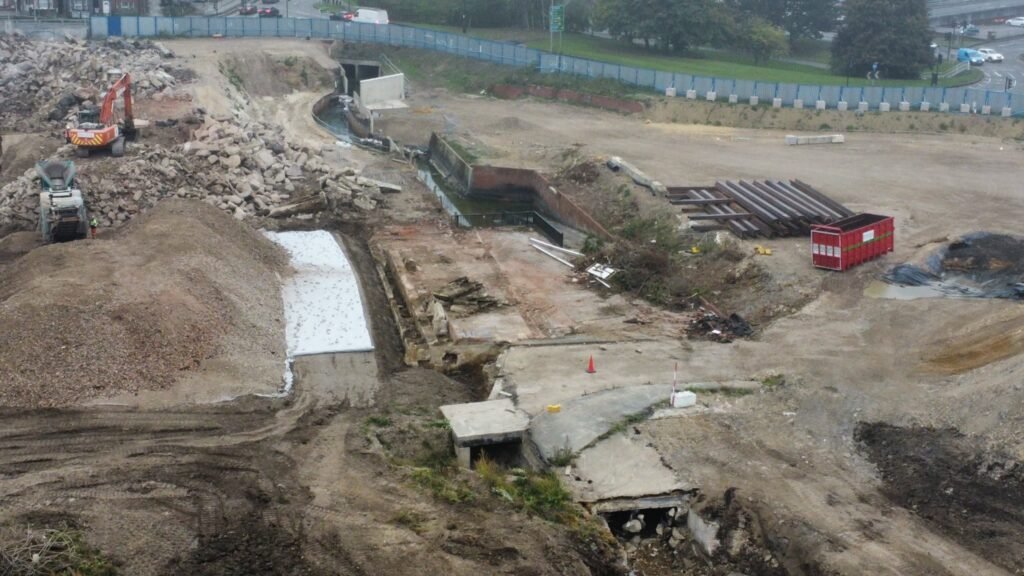
The former Power Court electricity substation was replaced and demolished to clear the stadium footprint.
Drainage and sewer construction
Drainage and sewer works remained one of the most visible activities during the autumn and winter.
Large concrete pipes, excavation areas and temporary working routes appeared across the site as sections of the new network were installed. Existing infrastructure then had to be transferred or removed before the ground could be prepared for the stadium foundations.
This phase was particularly important because a large modern stadium requires substantial drainage, foul-water and utility capacity.
Preparations for piling
During December 2025, the first piling equipment arrived at Power Court.
A tower-crane base had also been constructed, while drainage, ground clearance and preparation continued around the future stadium footprint. This represented the clearest indication that the project was about to move from enabling works into the main structural construction phase.
The principal piling operation subsequently began in January 2026.
Power Court at the end of 2025
By the end of the year:
- Limak was leading the stadium construction programme;
- the River Lea diversion was operational;
- the replacement Power Court electricity substation had been commissioned;
- the former substation had been demolished, releasing land within the stadium footprint;
- major drainage and sewer works were progressing;
- the stadium footprint had been cleared and prepared;
- construction compounds and access routes had been established;
- the first tower-crane base had been built; and
- piling equipment had arrived on site.
The transformation into a recognisable stadium would accelerate considerably during 2026.

Power Court at the end of 2025 as the site was prepared for piling and structural construction.
How will supporters travel to Power Court?
Power Court is close to Luton railway station, the town-centre bus network and the Luton–Dunstable Busway.
Its central location is intended to allow a greater proportion of supporters to arrive by train, bus or on foot than at an out-of-town stadium. Matchday transport arrangements are expected to include walking routes from Luton station, shuttle buses, interceptor parking, controlled parking measures and additional bus services.
The planning assessment includes 312 on-site stadium and broadcast parking spaces, so public transport will be central to the matchday travel strategy.
Power Court construction timeline
2015
2020 Developments was established with the aim of securing a new stadium for Luton Town and delivering major regeneration in central Luton.
2016
Luton Town revealed its proposals to relocate from Kenilworth Road to Power Court.
2019
Luton Borough Council resolved to approve the outline Power Court proposals in January 2019, with formal planning permission issued in September 2019.
2022
Updated plans for the wider Power Court site were approved, including up to 1,200 homes and additional commercial development.
February 2024
A planning application was submitted for engineering works, ground remediation and the creation of a development platform across the site.
September 2024
Luton Town submitted the detailed planning application for the new stadium.
December 2024
Luton Borough Council approved the new 25,000-seat stadium plans.
April 2025
Luton Town announced its construction partnership with Limak International and confirmed that the stadium was planned to open for the 2028/29 season.
January 2026
Deep piling began around the stadium footprint following extensive ground preparation and remediation work.
April 2026
Tower cranes began rising above the Power Court site as construction moved into the visible concrete superstructure phase.
July 2026
The West Stand reached its intermediate level across a significant section. Columns were rising around the South Stand and foundations became visible around the East Stand.
Late 2026
The stadium’s structural steel frame and roof are expected to begin taking shape.
2027–2028
Cladding, internal construction, mechanical and electrical installation, pitch work, testing and commissioning are expected to continue.
2028/29 season
Luton Town currently plans to play its first full season at Power Court.
Latest Power Court construction videos
Wandering Northerner regularly films the Power Court construction site from above, providing a clear view of progress across every stand.
The videos follow:
- piling and foundation work
- concrete stand construction
- tower crane activity
- structural steel installation
- roof construction
- changes to surrounding roads
- River Lea works
- public-realm construction
- neighbouring Luton regeneration projects
WATCH THE LATEST POWER COURT VIDEO
Frequently asked questions
How can I follow construction?
Wandering Northerner publishes regular drone videos, photographs and written updates showing progress across the Power Court site.
Follow Luton Town Power Court construction
Follow Wandering Northerner on YouTube and Facebook for regular construction updates from Power Court