
A428 Black Cat to Caxton Gibbet Construction Updates
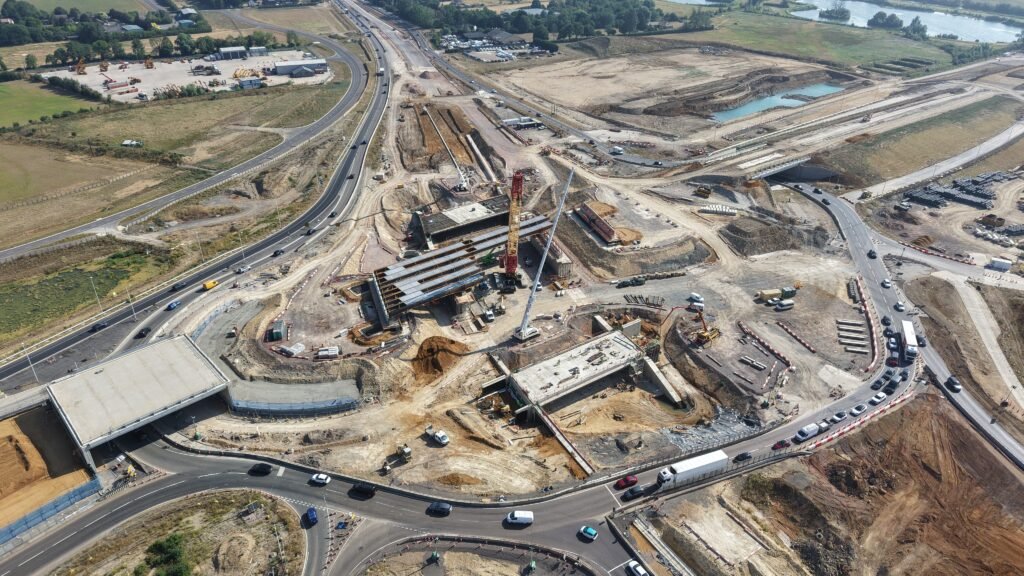
Follow construction of the £1 billion A428 Black Cat to Caxton Gibbet improvement scheme with regular drone footage, photographs and progress reports from Wandering Northerner.
The project is transforming the Black Cat Roundabout, building a new 10-mile dual carriageway towards Cambridge and completely rebuilding the junction at Caxton Gibbet.
This page explains what is being constructed, how the new Black Cat junction will work and when the different sections are expected to open.
Last updated: July 2026
Latest Black Cat Roundabout construction update
The Black Cat Roundabout is now almost unrecognisable compared with the junction that existed before construction began.
During July 2026, the final bridge beams were lifted into place for the new A421 flyover. These huge beams span the centre of the junction and will eventually carry traffic between Bedford and Cambridge above the A1.
Work is continuing beneath the new flyover to lower the A1 through the centre of the junction. New slip roads, bridge decks, retaining structures and sections of permanent carriageway are also taking shape around the site.
Several new road connections have already opened, including the free-flow link from the A421 eastbound to the A1 northbound. This allows drivers to avoid the existing roundabout completely.
New videos are normally published as construction progresses at Black Cat, Caxton Gibbet and along the new dual carriageway.
A428 Black Cat to Caxton Gibbet: project at a glance
- Project: A428 Black Cat to Caxton Gibbet improvements
- Location: Bedfordshire and Cambridgeshire
- Client: National Highways
- Main contractor: Skanska
- Estimated cost: Approximately £1 billion
- New road: Around 10 miles of dual carriageway
- New road number: A421
- Main construction started: December 2023
- Majority of scheme due to open: Spring 2027
- Black Cat A1 underpass due to open: Mid-summer 2027
- Major structures: 18 new bridges across the complete scheme
What is being built between Black Cat and Caxton Gibbet?
The project replaces the existing single-carriageway A428 between the Black Cat junction and Caxton Gibbet with a new dual carriageway.
It fills the remaining single-carriageway gap on the strategic east-to-west route between Milton Keynes, Bedford, St Neots and Cambridge.
The scheme includes:
- a new three-level junction at Black Cat
- a new 10-mile dual carriageway
- a viaduct over the River Great Ouse
- a new bridge over the East Coast Main Line
- a new junction at Cambridge Road near St Neots
- new bridges at Barford Road, Potton Road and Toseland Road
- improvements at Eltisley
- a two-level junction at Caxton Gibbet
- new routes and crossings for pedestrians, cyclists and horse riders
The existing A428 will remain available as a local road serving villages and communities along the route.
How will the new Black Cat junction work?
The familiar Black Cat Roundabout is being transformed into a three-level junction.
Upper level: the A421 flyover
Traffic travelling between Bedford and Cambridge will cross the junction on the new A421 flyover.
This means through traffic will no longer need to stop at traffic lights or travel around the ground-level roundabout.
The flyover is formed from several bridge structures passing above the centre of the junction.
Ground level: local connections
The ground-level junction will continue to connect local roads and allow drivers to change between the A1, A421 and Bedford Road.
Slip roads will take traffic between the different levels of the junction.
Lower level: the A1 underpass
The A1 is being lowered into a cutting beneath the junction.
Once the underpass opens, northbound and southbound A1 traffic will be able to travel underneath the A421 flyover without stopping at the roundabout.
This is the most complex part of the Black Cat construction project and is expected to be the final major section to open.
Why is the A1 being lowered at Black Cat?
The A1 currently passes directly through the signal-controlled Black Cat Roundabout, creating queues whenever traffic builds on the A1 or A421.
Lowering the A1 allows north-to-south traffic to pass underneath the junction without meeting traffic lights or the roundabout.
At the same time, the elevated A421 will carry east-to-west traffic over the top.
The result will effectively be three routes stacked on different levels, reducing the conflict between vehicles travelling in different directions.
The new A421 dual carriageway
Although the project is normally called the A428 Black Cat to Caxton Gibbet scheme, the new road will officially become part of the A421.
The A421 currently runs from the Milton Keynes and Bedford direction to Black Cat. Once the project opens, it will continue east from Black Cat to Caxton Gibbet.
The existing A428 will be renumbered:
- A1428 between Great North Road in St Neots and Cambridge Road
- B1428 between Cambridge Road and Caxton Gibbet
Keeping the old route open will provide access to local villages while longer-distance traffic uses the new dual carriageway.
River Great Ouse viaduct
One of the largest structures on the route is the new viaduct over the River Great Ouse near Little Barford.
The structure carries the new dual carriageway across the river and surrounding floodplain.
Twenty main bridge beams and hundreds of smaller crossbeams were installed to form the structure. Construction then moved on to the bridge deck, road surface, drainage and safety barriers.
The viaduct connects the Black Cat section of the project with the new road heading towards St Neots.
East Coast Main Line bridge
The new dual carriageway also crosses the East Coast Main Line railway between London and Edinburgh.
A completely new bridge has been constructed over the railway, with large embankments built on either side to carry the road towards the structure.
Railway possessions and carefully planned engineering operations were needed to complete work above one of Britain’s busiest railway lines.
Cambridge Road junction
A new grade-separated junction has been constructed at Cambridge Road, east of St Neots.
Two roundabouts sit on either side of the new route and are linked by a bridge. The main dual carriageway passes underneath in a cutting.
The junction will provide access between the new A421, St Neots town centre and St Neots railway station.
Parts of the new Cambridge Road layout have already opened, while work continues on the main carriageway and slip roads beneath it.
Eltisley improvements
The road layout at Eltisley has also been substantially rebuilt.
New roundabouts and a bridge carry local traffic across the route of the new dual carriageway. There will not be direct access to the new A421 from Eltisley, with the nearest full junction located at Caxton Gibbet.
The changes are intended to improve safety and separate local journeys from faster through traffic.
Caxton Gibbet junction
At the eastern end of the scheme, Caxton Gibbet is being transformed into a two-level junction.
The new A421 will pass over the junction on a flyover before connecting with the existing A428 towards Cambridge.
Local traffic using the A1198 and surrounding roads will continue to use the ground-level roundabouts.
New slip roads will allow drivers to enter or leave the dual carriageway at Caxton Gibbet.
When will the new A428 and Black Cat junction open?
National Highways plans to open the project in phases.
Spring 2027
The majority of the scheme is expected to open in spring 2027, including:
- the new 10-mile A421 dual carriageway
- the A421 flyover at Black Cat
- access to the dual carriageway at Cambridge Road
- the upgraded Caxton Gibbet junction
Traffic using the A1 will temporarily continue to travel through the ground-level Black Cat junction.
Mid-summer 2027
The final major phase will be the opening of the lowered A1 underpass beneath Black Cat junction.
Once this opens, the complete three-level junction will become operational.
Opening dates may change as construction progresses, particularly where work is affected by utilities, weather or traffic management.
A428 Black Cat to Caxton Gibbet timeline
2019
The preferred route and three-level Black Cat junction design were announced.
August 2022
The project received its Development Consent Order, providing formal permission for construction.
December 2023
Main construction officially began at Black Cat.
2024
Major earthworks, utility diversions, piling and bridge construction took place across the route.
2025
Several new local roads, bridges and temporary traffic layouts opened. The Cambridge Road and Eltisley layouts became clearly visible, while construction accelerated at Black Cat and Caxton Gibbet.
July 2026
The bridge beams forming the central A421 flyover at Black Cat were lifted into place. Excavation and construction of the lowered A1 continued beneath the new structures.
Spring 2027
The majority of the new A421 and its upgraded junctions are expected to open.
Mid-summer 2027
The new A1 underpass at Black Cat is expected to become operational.
Why is the A428 being upgraded?
The old A428 between St Neots and Caxton Gibbet is mainly single carriageway and has historically suffered from congestion, unreliable journey times and delays following incidents.
Black Cat Roundabout has also been one of the best-known congestion points on the A1.
National Highways expects the project to:
- reduce peak journey times by up to 10 minutes
- improve reliability between Milton Keynes and Cambridge
- separate local traffic from longer-distance journeys
- improve road safety
- remove thousands of vehicles from local village roads
- improve routes for pedestrians, cyclists and horse riders
What happened to the Black Cat statue?
The black cat sculpture became a familiar landmark after it was first installed on the roundabout in 2004.
The statue has disappeared, been replaced and suffered several cases of vandalism over the years.
Before major construction began, National Highways removed the latest version for safekeeping. It is being stored at one of the project’s site offices and is expected to return when the new junction is complete.
Despite the scale of the rebuilding work, the Black Cat name and its famous landmark are not disappearing.
Frequently asked questions
Is the Black Cat Roundabout being removed?
The existing layout is being replaced by a three-level junction. A ground-level junction will remain for drivers changing between routes, but A1 and A421 through traffic will use separate free-flowing levels.
Why is it called Black Cat Roundabout?
The name is associated with the former Black Cat Garage, which once stood near the junction. The black cat sculpture later became the best-known symbol of the roundabout.
Will the new road be called the A428?
No. The new dual carriageway between Black Cat and Caxton Gibbet will become part of the A421.
What will happen to the existing A428?
The existing road will remain as a local route. It will be renumbered as the A1428 and B1428.
When will Black Cat Roundabout be finished?
Most of the upgraded junction and the new A421 flyover are expected to open in spring 2027. The lowered A1 underpass is currently expected to open in mid-summer 2027.
How long is the new dual carriageway?
The new route is approximately 10 miles or 16 kilometres long.
Who is building the A428 Black Cat scheme?
The project is being delivered for National Highways, with Skanska as the main construction contractor.
Where can I see the latest construction footage?
Wandering Northerner publishes regular drone videos and photographs showing progress at Black Cat, Caxton Gibbet and along the full A428 improvement scheme.
Follow the construction
Subscribe to Wandering Northerner on YouTube for regular aerial construction updates from the A428 Black Cat to Caxton Gibbet project.
You can also follow Wandering Northerner on Facebook for photographs, shorter videos, roadwork news and updates between the main YouTube films.
Wandering Northerner is an independent construction-update website and is not affiliated with National Highways or Skanska.